
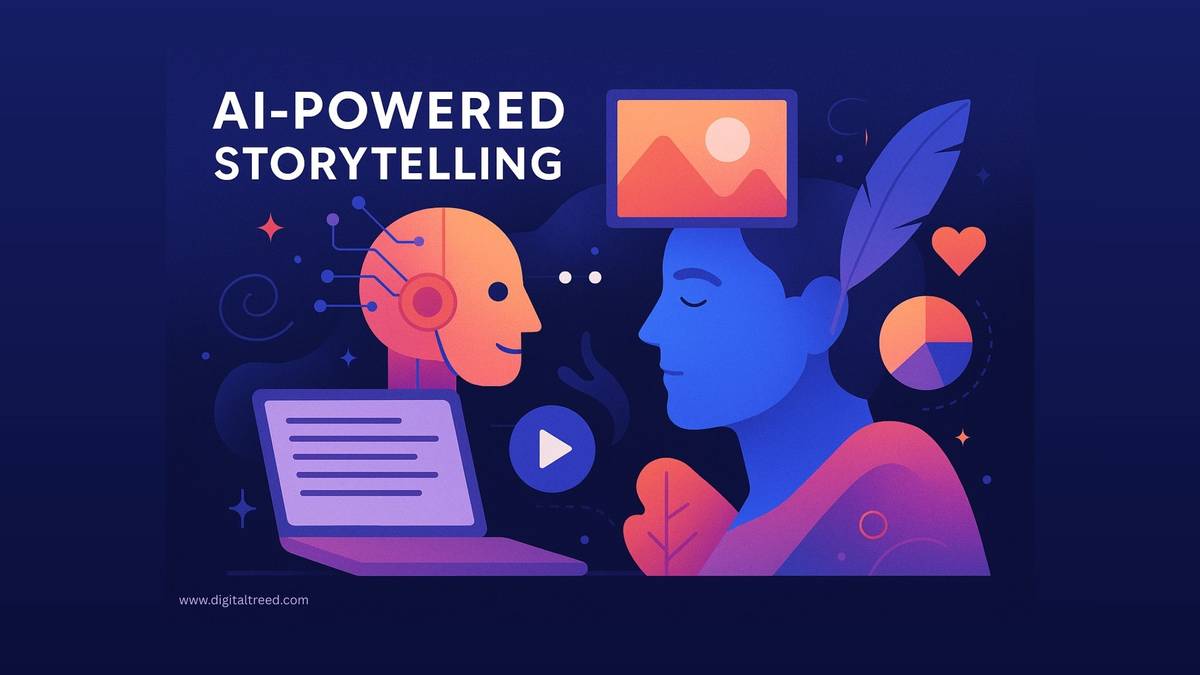
The New Language of Creativity
Stories have always defined humanity. From cave paintings to cinema, we’ve used narrative to make sense of the world, share emotion, and inspire change. But in the digital age, storytelling is evolving once again — this time with a partner that doesn’t dream, breathe, or sleep: Artificial Intelligence (AI).
AI-powered storytelling is not science fiction anymore. It’s the next evolution of communication — where algorithms learn to craft emotion, structure narratives, and personalize messages at a scale never before possible. From advertising campaigns to Hollywood scripts, machine intelligence is quietly rewriting how stories are born, told, and remembered.
How AI Became a Storyteller
From Data to Drama
Traditional storytelling was instinctive — a blend of human imagination and lived experience. AI, by contrast, builds its stories through pattern recognition. It reads millions of novels, scripts, and articles to understand what makes a story work: pacing, character arcs, tension, and resolution.
Modern large language models (LLMs) like GPT and Claude don’t just copy existing plots — they analyze storytelling grammar itself. They detect emotional frequency in language, identify archetypes, and generate narratives that mimic the rhythm of human storytelling.
For example, researchers at Stanford University found that AI-generated short stories scored within 10% of human-written ones on emotional engagement metrics when evaluated blindly by readers. The gap between algorithm and author is closing faster than most imagine.
Teaching Machines Emotion
One of the great challenges in storytelling is not logic, but feeling. AI systems are being trained not only to understand language but to interpret sentiment. Using affective computing, they analyze emotional cues in text — joy, fear, anticipation — and learn to replicate them.
In film and advertising, AI can now predict which narrative structures evoke the strongest emotional responses based on millions of data points from viewer reactions, heart rate monitors, and facial expression analysis. The result is data-driven empathy — emotion quantified and encoded.
The Rise of AI Storytelling in Marketing
Brands as Storytellers
Modern brands are no longer just sellers of products — they are storytellers of identity. Nike doesn’t sell shoes; it sells determination. Apple doesn’t sell devices; it sells creativity. In this new economy of meaning, AI has become the storyteller’s most powerful ally.
AI analyzes customer data — behavior, demographics, engagement — to generate hyper-personalized narratives. It can craft brand stories that evolve dynamically with each customer’s journey.
According to Accenture’s 2024 Marketing Report, campaigns built with AI-driven storytelling techniques see an average 38% higher engagement rate and 24% faster conversion cycle compared to traditional digital ads.
Narratives That Adapt in Real Time
In the age of AI, stories no longer have fixed endings. Platforms can now adjust messaging mid-campaign based on real-time audience feedback. For example, streaming services like Netflix use AI to customize trailers for different users — action-driven versions for thrill seekers, character-focused edits for romantics.
The same principle applies to branding: AI systems can rewrite email copy, headlines, or visuals dynamically, ensuring every audience segment receives a story that feels personal. Storytelling becomes alive — not linear, but adaptive.
Human + Machine: A New Creative Partnership
When Writers Collaborate with Algorithms
Far from replacing writers, AI has become a partner in the creative process. It can draft plotlines, refine tone, and even suggest metaphorical language. Yet, the human touch — context, irony, subtext — remains irreplaceable.
Writers at The Washington Post use their in-house AI system Heliograf to generate data-driven reports, allowing journalists to focus on deeper analysis. Similarly, creative teams at Ogilvy and Wieden+Kennedy use AI-powered brainstorming tools to spark new campaign ideas, treating the machine as an infinite whiteboard for ideation.
As creative director Marina Lopez puts it:
“AI doesn’t steal your voice — it echoes it until you find your best version.”
This human-machine collaboration defines the new age of creativity.
The Democratization of Storytelling
AI has lowered the barriers to storytelling. Tools like Runway, ChatGPT, and Synthesia allow anyone — regardless of writing or production skills — to create cinematic narratives, podcasts, or interactive stories.
Independent creators are now producing film-quality trailers and virtual characters entirely through AI tools, once accessible only to major studios. This democratization signals a shift from storytelling as an elite craft to storytelling as a universal language.
The Midpoint: Where Imagination Meets Intelligence
The intersection of human intuition and machine logic is where true creative power emerges. Writers, marketers, and artists are discovering that when they combine their emotional insight with algorithmic precision, new forms of expression arise.
For example, a designer can generate moodboards based on audience sentiment; a copywriter can instantly test different narrative arcs across demographics. Instead of guessing what resonates, creators now build with evidence.
Curious professionals increasingly explore intelligent platforms like https://overchat.ai/, where interactive dialogue between user and AI helps refine storytelling structure, tone, and rhythm. These systems act as sparring partners for creativity — interpreting feedback, suggesting alternatives, and helping ideas evolve organically.
It’s not about machines telling stories; it’s about machines helping us tell better stories.
AI in Film, Music, and Interactive Media
Cinematic Algorithms
AI has already begun transforming how we experience entertainment. In Hollywood, studios use machine learning to predict audience reactions to scripts before filming even begins. Systems like Cinelytic analyze story arcs, character dynamics, and box office history to assess potential success.
Filmmakers use AI to generate visual concepts, simulate lighting, or even “de-age” actors. Meanwhile, experimental directors are training AI models on thousands of films to generate surreal, dreamlike sequences — blending human direction with computational imagination.
Music That Learns the Listener
In music, AI-powered platforms such as Amper and AIVA compose original scores based on mood and theme. These systems learn an artist’s style and create variations that expand their sonic palette.
British composer Holly Herndon, who performs alongside an AI clone of her voice, describes it as “singing in harmony with the future.” The machine becomes both instrument and collaborator — the silent muse that never tires.
The Science Behind Inspiration
Pattern Recognition as Creativity
At its core, creativity is the ability to connect unrelated ideas into something new. AI excels at this — recognizing deep patterns invisible to the human eye. By scanning billions of data points across literature, culture, and emotion, it identifies unexpected associations that inspire innovation.
In one experiment, researchers trained an AI model on ancient myths and modern science fiction. The result? Completely new hybrid stories — mythological epics set in quantum universes. The machine didn’t “imagine” this; it combined centuries of narrative DNA in ways humans might never have considered.
When Data Feeds the Muse
For brands, AI inspiration comes from analytics. Sentiment analysis reveals which stories move audiences, while predictive models suggest what narratives will trend next season. It’s creativity with feedback — intuition powered by insight.
The future copywriter or creative strategist will need to understand not only storytelling, but story metrics — how emotions, timing, and visuals interplay to drive engagement and meaning.
Ethics and Authenticity in AI Storytelling
Who Owns the Story?
AI-generated content raises complex ethical questions. If a machine writes a script, who is the author? The programmer? The user? The model’s training data? Current legal frameworks recognize the human prompter as the owner, but debates continue.
Ethical storytelling also requires transparency. Audiences deserve to know when AI contributes to what they read, hear, or watch. Rather than hiding AI’s role, many creators are choosing to celebrate it — framing the process as co-creation between human and machine.
The Risk of Homogenization
When every AI system learns from the same dataset, storytelling risks becoming formulaic. True innovation requires diversity — in data, voices, and perspectives. Forward-thinking creators are therefore training models on culturally varied and inclusive datasets, ensuring that machine-generated stories reflect the global mosaic of human experience.
The Future: Machines That Inspire Humanity
Beyond Automation — Toward Co-Imagination
The next leap in storytelling won’t be about AI generating more content; it will be about AI inspiring content. Machine learning will act as a mirror for human emotion, reflecting back our deepest themes — love, struggle, hope — through new creative forms.
We are entering an era of co-imagination, where inspiration flows both ways: humans feed data to machines, and machines feed perspective to humans.
As storytelling futurist Dr. Elena Chang notes:
“AI doesn’t compete with human creativity — it completes it. Together, we create new mythologies for the digital age.”
Conclusion: The Human Story Continues
AI-powered storytelling represents not the death of art, but its evolution. It challenges writers, marketers, and creators to think bigger — to blend logic with empathy, and imagination with information.
Machines can now learn to write, compose, and visualize, but the heart of storytelling — why we tell stories — remains profoundly human.As technology learns to inspire, our role shifts from being mere authors to architects of inspiration. And in that collaboration lies the next great narrative — one written by humans, interpreted by algorithms, and shared with the world.

Aijaz Alam is a highly experienced digital marketing professional with over 10 years in the field. He is recognized as an author, trainer, and consultant, bringing a wealth of expertise to his work. Throughout his career, Aijaz has worked with companies such as Arena Animation (Aptech Ltd) and Matik Sports Private Limited. He previously operated a successful digital marketing website, Whatadigital.com, where he served an impressive roster of Fortune 250 companies. Currently, Aijaz is the proud founder and CEO of Digitaltreed.com.

About us and this blog
We are a digital marketing company with a focus on helping our customers achieve great results across several key areas.
Request a free quote
We offer professional SEO services that help websites increase their organic search score drastically in order to compete for the highest rankings even when it comes to highly competitive keywords.
Subscribe to our newsletter!
More from our blog
See all posts





I am sure this article has touched all the internet viewers, its really really good paragraph on building up new weblog.