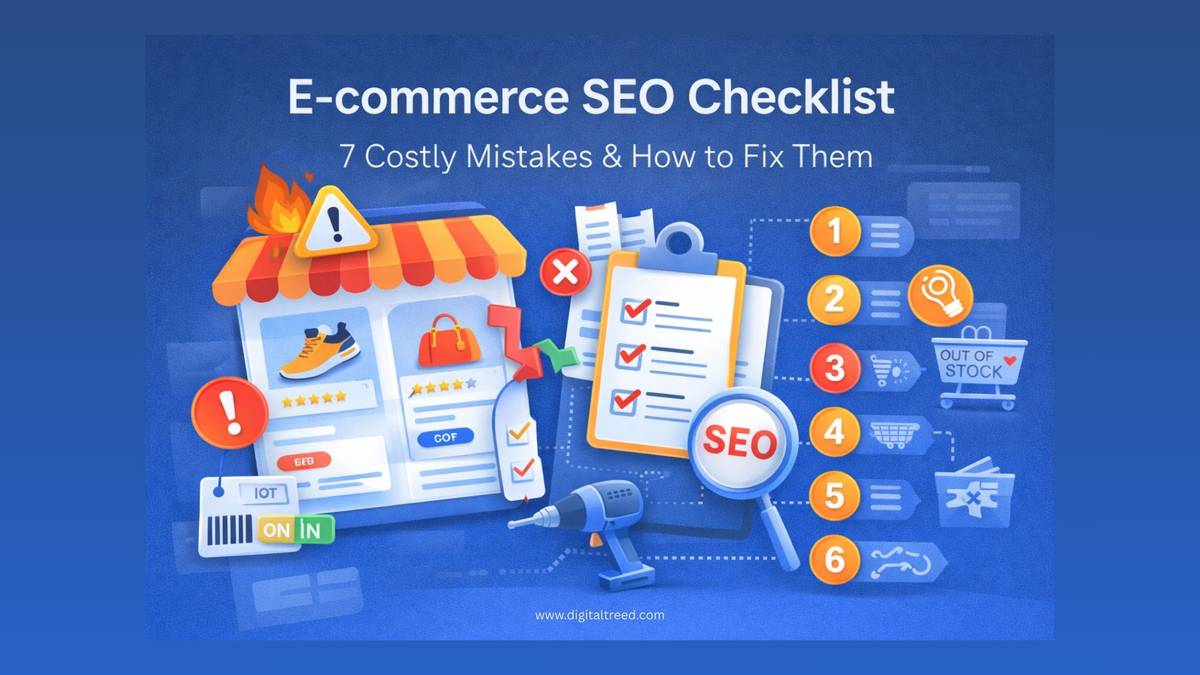
E-commerce SEO usually doesn’t fail just because of one big problem. It fails in many small ways, with little decisions made over time that add up to pages that don’t rank, products that don’t get discovered, and categories that never really take off.
If you're managing SEO in-house, working with an ecommerce SEO service, or planning to opt for professional assistance, review this checklist, because a few common mistakes often cause most ranking drops or static, low rankings.
Mistake #1: Treating Category Pages Like “Just a List of Products”
Many stores invest time in product pages and ignore category pages. But category pages are often where the real SEO opportunity lies, especially for high-volume searches (e.g., “running shoes,” “desk chairs,” “gift baskets”).
What Goes Wrong:
- A category page has only a title, a grid of products, and maybe a sentence or two.
- Filters create dozens of near-identical versions of the same page.
- There’s no reason for Google to rank the page over competitors with stronger content and clearer intent.
How to Fix It:
- Add a short, helpful introduction (120-200 words) that answers what people want to know before buying.
- Use a simple structure: what the category is, how to choose, who it’s for, and what to look for.
- Add internal links to subcategories, so Google understands the hierarchy.
- If the category is large, include FAQs that people actually search for.
Note that this is not about stuffing keywords. It’s about making the page useful enough to deserve a ranking.
Mistake #2: Repeating Content Across Products
Duplicate content is everywhere in e-commerce. It happens when:
- You use supplier text.
- Variants share the same description.
- You re-list the same product under multiple categories with identical copy.
What Goes Wrong:
- Google sees pages as “the same” and struggles to understand which version matters.
- It dilutes rankings or causes pages to remain ignored.
How to Fix It:
- Rewrite the first 150-200 words of every product description to make it distinct and specific.
- Add unique “decision content” that isn’t generic: sizing guidance, use cases, compatibility notes, care instructions, what’s included, and who it’s best for.
- For variants (size/color), keep a shared block if needed, but add variant-specific details above or below (fit, finish, weight, dimensions, what changes).
Mistake #3: Letting Filters and Faceted Navigation Create Index Bloat
Filters are great for shoppers. They can be a nightmare for SEO if every filter combination becomes a crawlable, indexable URL.
What Goes Wrong:
- Thousands of low-value pages get created (for example: ?color=black&size=10&brand=x&sort=price)
- Google spends crawl budget on junk pages and misses the pages you actually want indexed.
- Duplicate content issues explode.
How to Fix It:
- Decide which filtered pages (a small set) are worth ranking.
- Use “noindex,” “follow” for filter pages that don’t have a unique value.
- Use canonical tags wisely.
- Block crawl traps where needed via robots.txt (carefully) or parameter handling tools, depending on the platform.
If you want some filtered pages to rank (e.g., “men’s black running shoes”), create curated landing pages with unique content instead of hoping the filter URLs do the job.
Mistake #4: Ignoring Speed and Core Web Vitals on Product and Category Pages
E-commerce pages are heavy, with large images, reviews, scripts, apps, tracking, chat widgets, and personalization layers. The result is often slow website speeds and a clunky experience, especially on mobile.
What Goes Wrong:
- Slow pages reduce crawl efficiency and hurt rankings.
- Users leave before the products load.
- Layout shifts make the page feel broken.
How to Fix It:
- Compress images (use next-gen formats where possible).
- Use lazy loading for images that appear further down the page.
- Reduce app/script clutter.
- Fix layout shift by reserving space for images, banners, and dynamic elements.
- Check performance across page templates.
Mistake #5: Skipping Structured Data or Implementing it Incorrectly
Structured data doesn’t guarantee rankings, but it can help your listings stand out. In e-commerce, this usually means product details and breadcrumb markup.
What Goes Wrong:
- No schema, so listings look “plain” compared to competitors.
- Wrong schema, so Google ignores it.
- Inconsistent data.
How to Fix It:
- Implement the product schema across product pages (with accurate fields).
- Add breadcrumbs and Breadcrumb schema to show hierarchy.
- Validate with Google’s Rich Results Test and fix errors.
- Keep availability accurate (especially if products go in/out of stock frequently).
Mistake #6: Weak Internal Linking and a Messy Site Structure
A common issue in e-commerce is that when the site grows and categories expand, internal linking becomes accidental. Products get buried, and important categories lack prominent links.
What Goes Wrong:
- Google can’t find or prioritize key pages.
- Link equity doesn’t flow to important pages.
- Shoppers struggle to navigate, which affects engagement.
How to Fix It:
- Make sure your major categories are reachable in 1-2 clicks from the homepage.
- Add internal links from category pages to relevant subcategories and buying guides.
- Use “related categories” modules thoughtfully.
- On product pages, link back to the parent category and relevant complementary categories.
- If you publish blog content, link it to the category pages it supports naturally, not forced.
Try This Simple Test: pick your top 10 revenue categories. Can you reach each in two clicks? Do they receive internal links from related pages? If not, fix that first.
Mistake #7: Mishandling Out-Of-Stock, Seasonal, and Discontinued Products
This is an SEO miss that most stores don’t notice until traffic drops.
What Goes Wrong:
- Out-of-stock pages get removed (404), losing rankings and links.
- Discontinued products remain indexed with no alternatives.
- Seasonal collections vanish and then restart from zero each year.
How to Fix It:
- If the product is temporarily out of stock, keep the page live and useful:
- Offer restock notifications (if applicable)
- Suggest close alternatives
- Keep key content intact.
- If discontinued, decide page-by-page:
- If it has traffic/links, keep it live and redirect strategically to the closest alternative.
- If there’s no meaningful replacement, consider a helpful “discontinued” page that routes users to relevant categories.
- For seasonal pages (for example, holiday collections, summer items), keep the URL consistent year over year and update content early.
Final Thoughts
A lot of e-commerce SEO work fails because teams “optimize” a handful of pages and expect the whole site to perform optimally. E-commerce doesn’t work like that. Most of your rankings come from templates, including category templates, product templates, filter logic, navigation patterns, and internal linking systems.
The good news is that once you fix the underlying systems, improvements scale to hundreds or even thousands of pages. That’s when SEO feels less like a guessing game and more like a predictable growth channel.

Aijaz Alam is a highly experienced digital marketing professional with over 10 years in the field. He is recognized as an author, trainer, and consultant, bringing a wealth of expertise to his work. Throughout his career, Aijaz has worked with companies such as Arena Animation (Aptech Ltd) and Matik Sports Private Limited. He previously operated a successful digital marketing website, Whatadigital.com, where he served an impressive roster of Fortune 250 companies. Currently, Aijaz is the proud founder and CEO of Digitaltreed.com.

About us and this blog
We are a digital marketing company with a focus on helping our customers achieve great results across several key areas.
Request a free quote
We offer professional SEO services that help websites increase their organic search score drastically in order to compete for the highest rankings even when it comes to highly competitive keywords.
Subscribe to our newsletter!
More from our blog
See all posts