For a long time, website accessibility was treated like a task you complete once and move on from. Run an audit, fix the issues, publish a report, and check the box.
That approach used to work, at least on paper. Today, it breaks down almost immediately.
Modern websites don’t stay the same for very long. They change daily, sometimes hourly, and accessibility issues tend to return quietly, often without anyone noticing.
Why Accessibility Was Treated as a One-Time Task
Accessibility audits became popular because they provided clarity. You could point to a report, show what was fixed, and feel confident that the site was compliant at that moment.
For static websites with infrequent updates, this made sense. Pages didn’t change much, and accessibility fixes stayed in place.
The problem is that most websites no longer behave that way.
How Modern Websites Actually Change Over Time
Today’s websites are built on CMS platforms, frameworks, and third-party tools that are constantly updated.
Content teams publish new pages. Marketing teams adjust layouts. Developers ship features. Plugins are added. Scripts change. Even small visual tweaks can introduce accessibility problems.
None of this triggers a new audit. Accessibility simply drifts.
What Breaks After a One-Time Accessibility Fix
Accessibility issues don’t usually come back in dramatic ways. They reappear quietly.
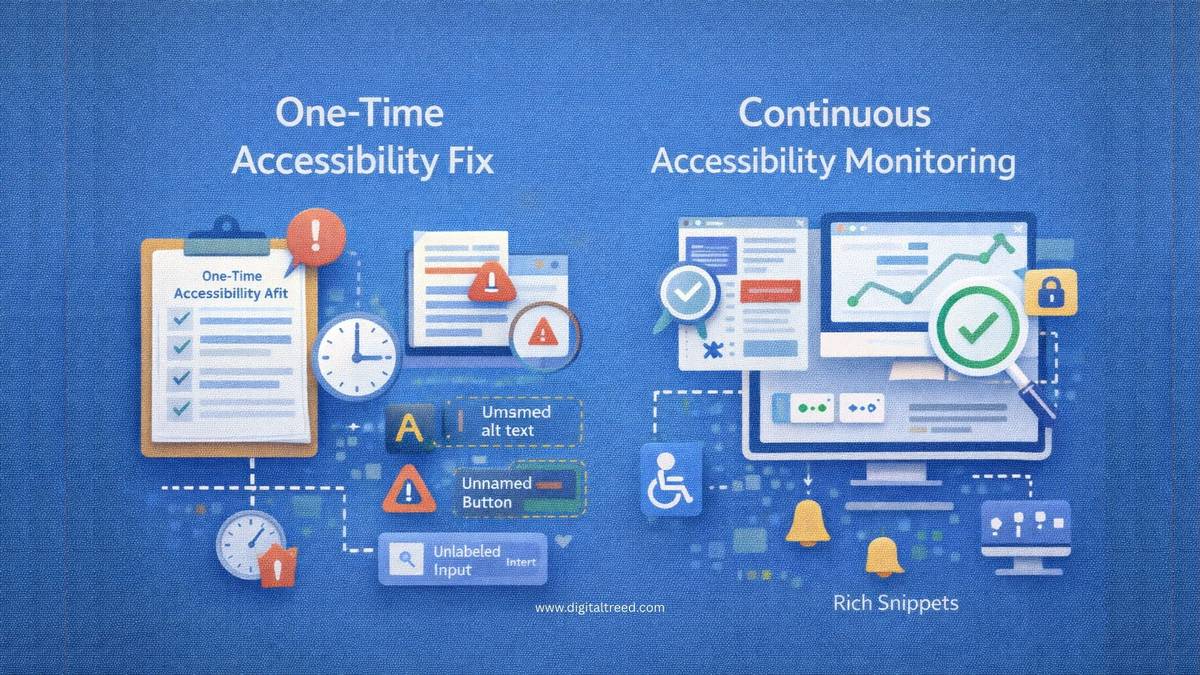
New images are added without proper descriptions. Buttons are restyled and lose focus visibility. Form updates introduce unlabeled fields. Content editors paste in elements that were never tested.
Over time, the site looks compliant on paper but behaves very differently for users who rely on assistive technologies.
The Gap Between Passing an Audit and Staying Accessible
An audit shows how a site performs at a specific moment. It doesn’t reflect what happens three weeks later or three months later.
This creates a false sense of security. Teams believe accessibility is handled, while real users encounter broken navigation, unreadable content, or unusable forms.
Accessibility is less about passing once and more about staying accessible as the site evolves.
Why Automated Fixes Alone Don’t Solve the Problem
Automated tools and widgets can help, but they aren’t a complete solution on their own.
They may catch common issues or apply adjustments at runtime, but they don’t always reflect how the underlying code behaves or how changes impact accessibility over time.
Without visibility into what’s actually breaking, teams don’t know where problems are coming from or how serious they are.
Accessibility as an Ongoing Process, Not a Project
The most reliable accessibility programs treat accessibility the same way they treat performance or security.
It’s monitored. It’s revisited. It’s part of regular workflows.
Instead of fixing everything once, teams focus on detecting issues early, tracking regressions, and addressing problems as part of ongoing development and content updates.
What Sustainable Accessibility Looks Like in Practice
Sustainable accessibility usually combines a few elements working together.
Issues are detected continuously, not just during audits. Changes are reviewed with accessibility in mind. Teams understand where problems come from and how often they reappear.
This approach doesn’t require rebuilding a site from scratch. It requires visibility and consistency.
How Web Accessibility Solutions Support Long-Term Compliance
This is where modern web accessibility solutions play a role. Rather than focusing only on reports or one-time fixes, they help teams understand what’s happening as the site changes. For teams looking beyond one-time fixes, platforms like provide a web accessibility solution centered on continuous detection and monitoring, making it easier to catch accessibility failures early and keep them from piling up over time.
The goal isn’t perfection in one moment. It’s maintaining accessibility over time.
Who Is Most Affected by One-Time Accessibility Approaches
One-time fixes tend to fail fastest on growing websites.
Content-heavy sites, ecommerce platforms, and businesses that release updates frequently are especially vulnerable. The more a site changes, the faster accessibility degrades without ongoing oversight.
For these teams, accessibility needs to move from a milestone to a process.
Moving From One-Time Fixes to Continuous Accessibility
Transitioning away from one-time fixes doesn’t mean starting over.
It usually starts with monitoring key pages, understanding where issues reappear, and integrating accessibility checks into existing workflows.
When accessibility becomes part of how a website is maintained, not just how it’s launched, it stops breaking quietly in the background.
That shift is what makes accessibility sustainable.

Aijaz Alam is a highly experienced digital marketing professional with over 10 years in the field. He is recognized as an author, trainer, and consultant, bringing a wealth of expertise to his work. Throughout his career, Aijaz has worked with companies such as Arena Animation (Aptech Ltd) and Matik Sports Private Limited. He previously operated a successful digital marketing website, Whatadigital.com, where he served an impressive roster of Fortune 250 companies. Currently, Aijaz is the proud founder and CEO of Digitaltreed.com.
About us and this blog
We are a digital marketing company with a focus on helping our customers achieve great results across several key areas.
Request a free quote
We offer professional SEO services that help websites increase their organic search score drastically in order to compete for the highest rankings even when it comes to highly competitive keywords.
Subscribe to our newsletter!
More from our blog
See all posts