Writing Meta Titles and Descriptions With AI Without Sounding Like a Robot
- January 27, 2026
- Aijaz Alam
- Search Engine Optimization
Meta titles and descriptions are tiny, high-stakes sentences living in the wild. They sit on the search results page wearing a little sandwich board, trying to convince a hurried stranger to choose you over ten other options. And because they’re small, people assume they’re easy. Then they write something like “Best Solutions for Your Needs | Brand Name” and wonder why Google and humans both yawn.
Now add AI to the mix and you get a new problem: speed without soul. AI can draft meta titles and descriptions in bulk, but it also tends to produce copy that sounds like it’s politely auditioning for a job at “Generic Internet, Inc.” The trick is not to ban AI from the process. The trick is to use AI as the engine while you keep your human hands on the steering wheel.
This post will show you how to do exactly that: how to write meta titles and descriptions with AI that are accurate, click-worthy, and distinctly non-robotic, without turning your workflow into an endless edit spiral.
Why AI Meta Copy Often Sounds Robotic
AI is trained to be broadly helpful and safe, which often translates into:
- predictable phrasing (“Discover,” “Explore,” “Learn more”)
- abstract promises (“high-quality,” “best-in-class,” “tailored solutions”)
- vague nouns (“solutions,” “services,” “resources”)
- repetitive structure (keyword + benefit + CTA + brand)
It’s not that AI is “bad at writing.” It’s that it’s optimized for average usefulness when it doesn’t have enough context. Your job is to give it constraints and raw material so it can write like your brand, not like a polite appliance.
First: Know What Meta Titles and Descriptions Are Actually For
Before the “how,” a quick reality check.
Meta titles:
- influence what shows as the clickable headline in results
- set topical relevance
- are a major first impression
- may be rewritten by search engines if they’re unclear, stuffed, or mismatched
Meta descriptions:
- don’t directly “rank” in the classic sense, but strongly influence click-through rate
- act as ad copy for organic search
- often get rewritten too, especially if they don’t match the query intent
So your goal isn’t just to include keywords. Your goal is to make the best promise for that query and then keep it.
If your snippet makes a claim the page doesn’t deliver, you might win the click and lose the user. That’s like handing someone a beautifully wrapped gift that’s empty inside. They will remember.
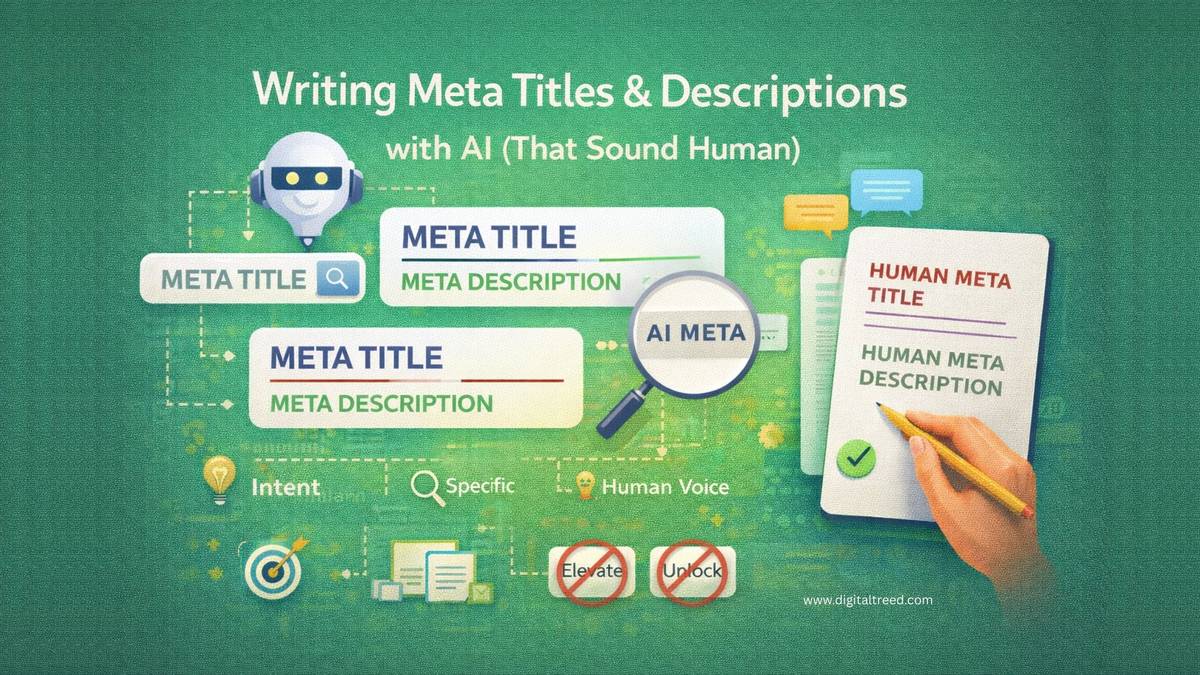
The Meta Copy Triangle: Intent, Specificity, Voice
Every great title and description balances three forces:
- Intent: What is the searcher trying to do right now?
- Specificity: What exactly will they get on this page?
- Voice: Does this sound like a real brand run by real humans?
AI tends to nail intent and stumble on voice. Humans tend to nail voice and sometimes forget specificity. Your workflow should force all three.
Step 1: Feed AI the Right Inputs (Stop Asking It to Guess)
The fastest way to get robotic copy is to prompt AI with only a URL and “write a meta title.” That’s like asking someone to write a movie trailer without seeing the film.
Instead, give AI this mini-brief for each page:
- Page type: product, category, blog post, landing page, FAQ, etc.
- Primary query intent: informational, transactional, comparison, navigational
- Primary keyword: the main phrase you want to align with
- Secondary cues: 2 to 4 related terms or entities
- Unique value: what makes your page different (shipping speed, expertise, niche focus, templates, examples, pricing transparency)
- Must-include phrase (optional): brand name or a key differentiator
- Must-avoid phrases: “best,” “#1,” or anything legally risky
- Tone: friendly, direct, professional, playful, premium, etc.
You’re giving AI rails to run on. Without rails, it takes the scenic route through Blandville.
Step 2: Ask AI for Variations With Different “Voices,” Not Just Different Words
A common mistake is asking for “10 options” and getting 10 versions of the same sentence wearing different hats.
Instead, request variations by approach. For example:
- Option A: benefit-forward
- Option B: specificity-forward (numbers, details, formats)
- Option C: curiosity-forward (without clickbait)
- Option D: urgency-forward (if appropriate)
- Option E: authority-forward (experience, expertise, proof)
This forces AI to produce meaningfully different angles. You can then pick the one that fits the page and the SERP landscape.
Step 3: Use a “No-Fluff” Filter (Kill the Robot Words)
Here’s a practical editing trick: make a blacklist of phrases that often signal robotic copy.
Common offenders:
- “Discover”
- “Explore”
- “Unlock”
- “Elevate”
- “Seamless”
- “Cutting-edge”
- “Next-level”
- “Solutions”
- “All-in-one”
- “Tailored”
- “High-quality” (unless you prove what “quality” means)
You don’t have to ban these forever. But if your meta copy is made of them, it will read like a brochure left in a dentist’s office in 2009.
Replace fluff with specifics:
- What kind of guide?
- What outcome?
- For who?
- What format?
- What makes it easier or faster?
Step 4: Add “Concrete Hooks” That Humans Actually Click
People click when they see themselves in the snippet. Concrete hooks help.
Hooks that work well:
- Numbers: “12 tips,” “5 steps,” “3 mistakes”
- Time: “in 10 minutes,” “quick checklist”
- Audience: “for beginners,” “for small teams,” “for ecommerce”
- Outcome: “reduce bounce rate,” “improve CTR,” “fix indexing”
- Format: “template,” “calculator,” “examples,” “checklist”
- Proof: “based on real audits,” “used by…” (only if true)
AI can suggest hooks, but you should choose hooks that match the page honestly.
Step 5: Make AI Write Like a Human by Giving It Human Lines
Want AI to sound less robotic? Feed it a few lines of your brand’s voice.
For example:
- A short brand tagline
- Two examples of your existing good meta descriptions
- A couple of sentences from your homepage that capture tone
- Your preferred style rules (no exclamation points, no hype, plain language, etc.)
AI is excellent at pattern matching. If you show it what “you” sounds like, it will imitate that instead of defaulting to generic.
Step 6: Keep Meta Titles Tight Without Feeling Cramped
There’s no single perfect character limit because results display differently by device and query. But you still want titles that:
- lead with the main topic
- include a differentiator
- avoid being chopped in a way that removes meaning
Practical guidelines:
- Put the most important words first
- Avoid front-loading your brand name unless brand recognition drives clicks
- Don’t repeat the same term twice (“AI SEO Audit AI Tools”)
- If you use separators (|, -, :), keep it consistent across your site
- If you’re writing for a local audience, include the location naturally
AI can help you compress titles by removing filler. A good prompt is “shorten this title without losing meaning, keep the main keyword near the front.”
Step 7: Write Meta Descriptions Like Micro-Sales Copy (But Not Like a Used Car Ad)
The best meta descriptions are:
- specific
- aligned with the query’s intent
- credible
- written in natural language
- clear about what the page contains
A reliable structure is:
- Sentence 1: what this page helps you do
- Sentence 2: what’s inside (formats, examples, steps) and why it’s worth clicking
Example pattern (not a template you must copy, just a rhythm): “Learn how to [solve problem] with [method]. Includes [specifics] so you can [outcome] without [pain point].”
AI is very good at this structure if you provide real specifics to plug in.
Step 8: Avoid the “Keyword Costume Party”
There’s a difference between including a keyword and wearing it like a foam mascot head.
Bad: “AI Meta Titles and Descriptions | AI Meta Title Generator for Meta Titles and Descriptions”
Better: “Write Meta Titles and Descriptions With AI That Sound Human”
A good rule: if the title sounds ridiculous when read aloud, it’s probably over-optimised.
Your keyword should feel like part of a sentence a person might actually say. AI can help you rewrite keyword-heavy drafts into natural language while keeping the topic clear.
Step 9: Match the Snippet to the Page, Not Your Wishful Thinking
AI will happily promise the moon. Humans have to make sure the page actually contains the moon and not just a blurry photo of it.
This is where a quick checklist helps:
- Does the page answer the implied promise?
- Are the claims accurate (pricing, availability, results)?
- Is the page up to date?
- Does the snippet match the content format (guide vs product vs tool)?
- If someone clicks, will they feel they landed in the right place?
If your meta description says “Free templates” and the page offers “ideas,” you’re building a mismatch that hurts trust and performance.
Step 10: Use Visual Content Wisely (Yes, It Can Influence CTR Indirectly)
Meta titles and descriptions don’t exist in isolation. User behaviour signals and on-page engagement matter. If people click, bounce quickly, and return to the results, your snippet can become a tiny trapdoor.
Adding strong visuals and clear formatting can improve engagement and time on page, which supports the whole system. This is also where stock photos an be a genuinely positive asset when used thoughtfully. When you choose high-quality stock photos that fit the topic and style, they can make content feel more polished, help illustrate concepts, and reduce the “wall of text” fatigue, especially in long guides. Pair them with captions, examples, or annotations so they support understanding, not just decoration.
Step 11: Build a Simple AI-to-Human Editing Workflow
Here’s a workflow that keeps your sanity intact:
- AI drafts 5 title options using different approaches (benefit, specificity, authority).
- AI drafts 3 description options with two-sentence structure and real page specifics.
- Human selects best candidate and edits for brand voice, accuracy, and clarity.
- Human applies the no-fluff filter (remove vague adjectives, generic CTAs).
- Human checks SERP fit quickly: does this stand out among what already ranks?
- Record what you used in a sheet so you can test and iterate later.
This approach is fast, consistent, and prevents AI from becoming the final author of your brand voice.
Step 12: Test and Iterate Like You Mean It
Meta copy is not sacred scripture. It’s more like a storefront sign: you can repaint it.
Practical testing ideas:
- Update titles/descriptions for your top 20 pages first
- Watch Search Console for changes in CTR over 2 to 4 weeks
- If impressions are stable but CTR rises, you’re onto something
- If CTR drops, compare your snippet to the SERP competition and revise
AI can help you generate alternative versions for testing, but humans should decide what’s worth testing and why.
Common Mistakes When Using AI for Meta Copy
- Letting AI write without giving it page context
- Using the same formula across every page (it becomes invisible)
- Making claims the page can’t support
- Stuffing keywords until the copy loses meaning
- Forgetting the audience (writing for “SEO” instead of humans)
- Never revisiting meta copy after it’s set
AI won’t fix strategy neglect. It will only speed it up.
The Takeaway
AI can write meta titles and descriptions faster than any human, but speed alone isn’t the goal. The goal is to create snippets that make a clear promise, sound like your brand, and attract the right click.
Use AI for drafting, variations, compression, and consistency. Keep humans in charge of tone, truth, differentiation, and intent alignment. That’s how you get the best of both worlds: production-line efficiency with a heartbeat.
Because when your meta copy reads like it was written by a real person who understands the searcher, the click feels less like a gamble and more like the obvious next step.

Aijaz Alam is a highly experienced digital marketing professional with over 10 years in the field. He is recognized as an author, trainer, and consultant, bringing a wealth of expertise to his work. Throughout his career, Aijaz has worked with companies such as Arena Animation (Aptech Ltd) and Matik Sports Private Limited. He previously operated a successful digital marketing website, Whatadigital.com, where he served an impressive roster of Fortune 250 companies. Currently, Aijaz is the proud founder and CEO of Digitaltreed.com.
About us and this blog
We are a digital marketing company with a focus on helping our customers achieve great results across several key areas.
Request a free quote
We offer professional SEO services that help websites increase their organic search score drastically in order to compete for the highest rankings even when it comes to highly competitive keywords.
Subscribe to our newsletter!
More from our blog
See all posts